


Sinus barotrauma in diving
Oskari H Lindfors, Anne K Räisänen-Sokolowski, Jari Suvilehto, Saku T Sinkkonen
Appendix 1. English translation of the questionnaire
1) Diving history
1.1) Diver type (select one or more)
☐ Professional diver
☐ Recreational diver
1.2) Diving type (select one or more)
☐ Free diving
☐ Scuba diving
☐ Technical diving
1.3) Diving education; level (select one or more)
☐ No diving courses
☐ Beginner course
☐ Advanced course
☐ Instructor course
☐ Professional course
☐ Course for first-responders
☐ Course for military divers
1.4) Diving education; type (select one or more)
☐ PADI
☐ CMAS
☐ BSAC
☐ NAUI
☐ SSI
☐ Other
1.5) Number of diving years
1.7) Number of dives per year during last five years
1.8) Employer
☐ Employer 1 (not disclosed here)
☐ Employer 2 (not disclosed here)
☐ Employer 3 (not disclosed here)
☐ Employer 4 (not disclosed here)
☐ Other / Recreational diver
2) Medical history
2.1) Sex
☐ Female
☐ Male
2.2) Age (years)
2.3) Height (cm)
2.4) Weight (kg)
2.5) Allergies
☐ Pollen
☐ Animals
☐ Food
☐ Other
☐ No allergies
2.6) Number of upper respiratory tract infections (URTIs) per year
2.7) When suffering from URTI I tend to not dive as planned (select one or more)
☐ Yes, when suffering from URTI with fever and significant congestion
☐ Yes, when suffering from URTI with no fever and mild congestion
☐ Never
2.8) Previous otorhinolaryngology-related (ORL-related) surgical procedures (select one or more)
☐ Adenoidectomy
☐ Myringotomy
☐ Myringoplasty
☐ Tympanostomy tubes
☐ Balloon eustachian tuboplasty
☐ Functional endoscopic sinus surgery
☐ Septoplasty
☐ Radiofrequency ablation of inf. turbinates
☐ Cleft palate repair
☐ None of the above
2.9) Smoking
☐ Never
☐ Occasionally
☐ Regularly
2.10) Number of active smoking years
2.11) Number of cigarettes per day
3) Questions related to pressure chamber testing and sinus barotraumas
3.1) I have been to hyperbaric pressure chamber testing to evaluate my pressure equalization ability
☐ Yes
☐ No
3.2) I have experienced sinus barotraumas during hyperbaric pressure chamber testing
☐ Yes
☐ No
3.3) I have experienced sinus barotraumas during hyperbaric pressure chamber testing X times
3.4) I have had concomitant URTI symptoms X times together with sinus barotraumas
3.5) The sinus barotraumas have mainly occurred when (select one or more)
☐ Increasing the chamber pressure
☐ Decreasing the chamber pressure
3.6) The sinus barotraumas have manifested as (select one or more)
☐ Pain in the maxillary (cheek) region
☐ Pain in the frontal (forehead) region
☐ Nosebleeds
☐ Other
3.7) Other, how?
3.8) The symptoms have typically dissipated in
☐ 2min
☐ 2h
☐ 2d
☐ >2d
3.9) I had had symptoms of poor pressure equalization preceding the problems during the hyperbaric pressure chamber test
☐ Yes
☐ No
3.10) I have had to ask for my pressure chamber test to be rescheduled due to my inability to equilibrate my sinus pressure
☐ Yes
☐ No
3.11) I have had to ask for my pressure chamber test to be aborted due to my inability to equilibrate my sinus pressure
☐ Yes
☐ No
4) Questions related to pressure equalization of the sinuses
4.1) I have had a sinusitis X times during my life
4.2) I have experienced sinus barotraumas while diving
☐ Never
☐ Sporadically
☐ Occasionally
☐ Almost always
☐ Always
5) Questions related to sinus barotraumas while diving
5.1) I have experienced sinus barotraumas X times
5.2) I have had concomitant URTI symptoms X times together with sinus barotraumas
5.3) The sinus barotraumas have mainly occurred (select one or more)
☐ When descending
☐ When ascending
5.4) The sinus barotraumas have occurred at a depth of X m
5.5) The sinus barotraumas have manifested as (select one or more)
☐ Pain in the maxillary (cheek) region
☐ Pain in the frontal (forehead) region
☐ Nosebleeds
☐ Other
5.6) Other, how?
5.7) The symptoms have typically dissipated in
☐ 2min
☐ 2h
☐ 2d
☐ 2d
5.8) I had had symptoms of poor pressure equalization preceding the problems during the dive
☐ Yes
☐ No
5.9) The sinus barotraumas have X during the years
☐ Decreased
☐ Remained unchanged
☐ Increased
6) Questions related to the increase of sinus barotraumas while diving
6.1) The increase in the symptoms started
☐ 0-4 years (after start of diving)
☐ 5-9 years
☐ 10-14 years
☐ 15-19 years
☐ 20-24 years
☐ 25-29 years
☐ 30-34 years
☐ 35-39 years
☐ 40-44 years
☐ 45-50 years
☐ Not sure
6.2) The increase in the symptoms started
☐ During an URTI
☐ During an middle ear infection
☐ During active allergies
☐ Gradually without an apparent cause
☐ Other
6.3) Other, how?
7) Questions related to the treatment of sinus barotraumas while diving
7.1) I have had to use non-prescribed medications due to my sinus barotrauma symptoms (select one or more)
☐ Yes, during the last 12 months
☐ Yes, earlier than during the last 12 months
☐ No
7.2) Name of the non-prescribed medication:
7.3) I have had to use prescribed medications due to my sinus barotrauma symptoms (select one or more)
☐ Yes, during the last 12 months
☐ Yes, earlier than during the last 12 months
☐ No
7.4) Name of the prescribed medication:
7.5) I have been to the following ORL-related surgical procedures due to my sinus barotrauma symptoms (select one or more)
☐ Adenoidectomy
☐ Functional endoscopic sinus surgery
☐ Septoplasty
☐ Radiofrequency ablation of inf. turbinates
☐ None of the above
7.6) I have been on sick leave due to my sinus barotrauma symptoms (professional divers only, select one or more)
☐ Yes, an independently taken sick leave
☐ Yes, a mandatory sick leave
☐ No
7.7) I have been on sick leave for X days during the last 12 months due to my sinus barotrauma symptoms (professional divers only)
7.8) I have tried to manage my sinus barotrauma symptoms by (open response)
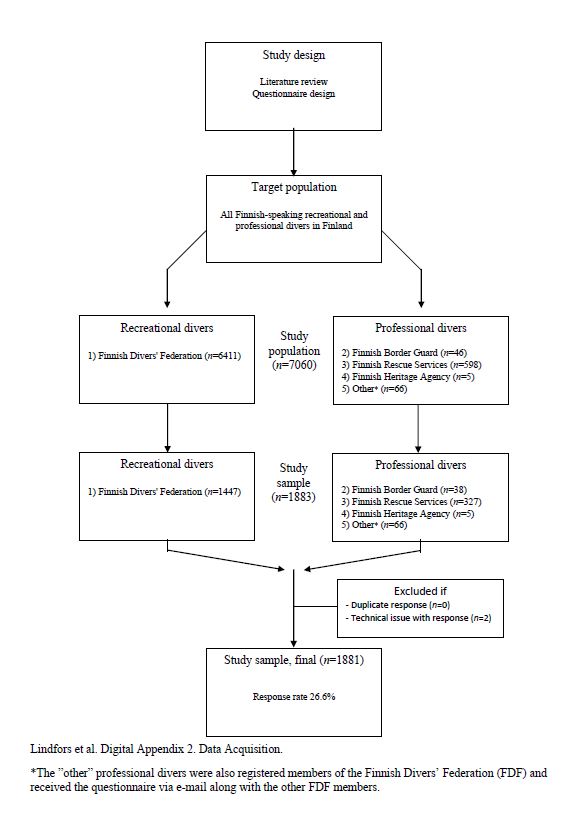
Appendix 2. Details of data acquisition
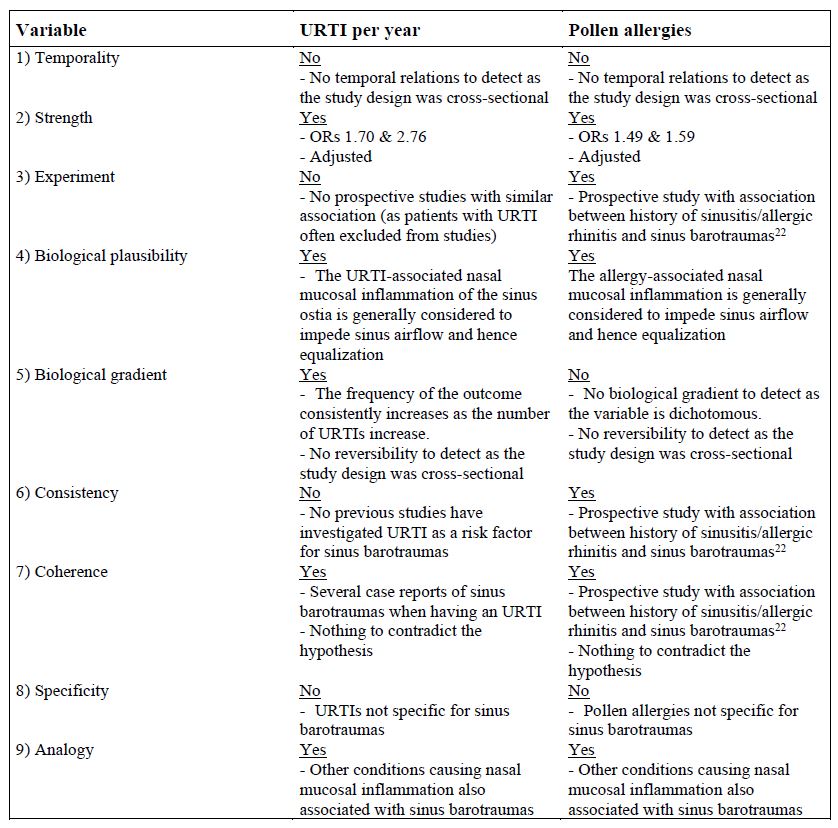
Appendix 3. Application of the Bradford-Hill guidelines for observational data: sinus barotraumas while diving and the condition’s possible risk factors
Application of the Bradford Hill guidelines for observational data: sinus barotraumas while diving and the condition’s possible risk factors. OR, odds ratio; URTI, upper respiratory tract infection