


Appendix 1 to Risberg et al. Decompression procedures for transfer under pressure (‘TUP’) diving.
Download a PDF of the supplementary file here.
Extended description of candidate TUP tables
Note: Reference numbers correspond to the reference list in the main paper with the exception of four additional references that are listed at the end of this document.34-37
US Navy (USN)
Revision 7 of the USN Diving Manual9 was published in 2016. The manual includes decompression tables for surface-oriented diving with air and Nitrox as the breathing gas in the bottom phase and air and Oxygen as the breathing gas during decompression (“In water air/O2”). These procedures were developed for in-water rather than closed bell decompression. The diver will breathe compressed air during decompression deeper than 9 msw and oxygen at the 9 and 6 msw decompression stops. After 30 min of oxygen breathing the diver will breathe compressed air for 5 min (“air break”). A contingency procedure allows conversion to air breathing in the event of failure of oxygen delivery. A repetitive dive may take place 0-16h after the first dive (in some cases 18h if no Repetitive Group has been assigned). The tables have been developed based on a publicly available algorithm and parameter set (Thalmann E-L, VVAL7918). The Thalmann E-L algorithm is a neo-Haldanian nine-compartments model with T1/2 5-240 min exponential gas uptake and linear gas elimination. This deterministic model has been validated against a probabilistic model based on more than 3000 carefully monitored experimental dives15. The tables have been developed by the US Navy Experimental Diving Unit (NEDU) and a team of scientists with competency in decompression theory have regularly revised and expanded the decompression tables.
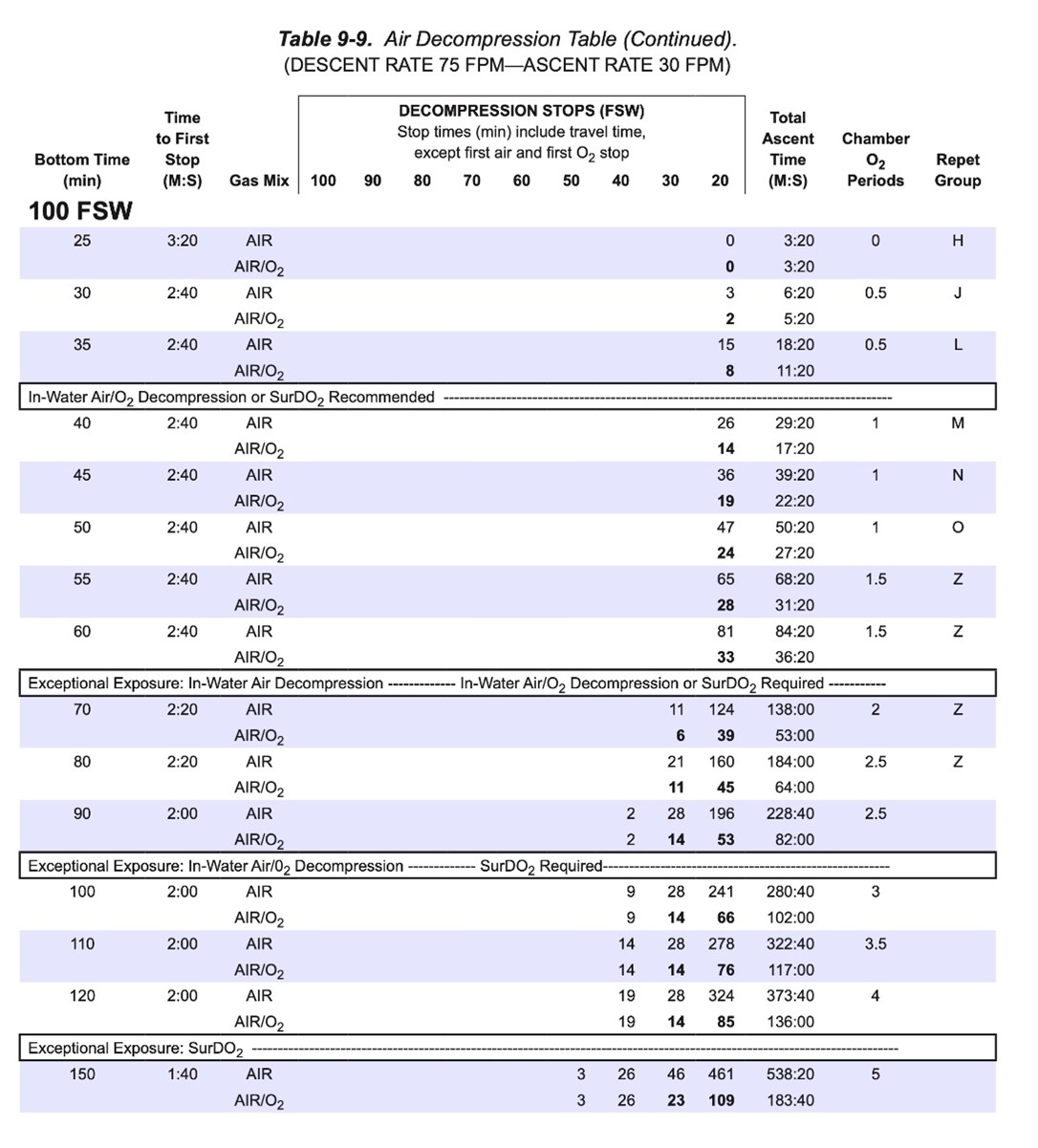
Facsimile from USN Diving Manual Rev 7 of the 100 fsw (30 msw) schedules for air and Air/O2 decompression.
MT92
The French MT 92 tables were originally published in the 1992 revision of the French diving regulations. They included a complete set of air and mixed gas tables, including Air/Standard (standard air table), Air/Oxy/6m (air tables with oxygen stop at 6msw intended for in-water decompression), Air/Oxy/12m (air tables with oxygen stop at 12 msw intended for closed bell /TUP decompression) and Air/Surface decompression. The tables came complete with nitrox, repetitive, altitude, caisson and split-level diving procedures. A contingency procedure allows conversion to air breathing in the event of a failure in oxygen delivery. The decompression for a repetitive dive is calculated based on the sum of the actual bottom time and a residual time-penalty from the preceding dive. The residual time-penalty will depend on the surface interval as well as the depth of the repetitive dive.
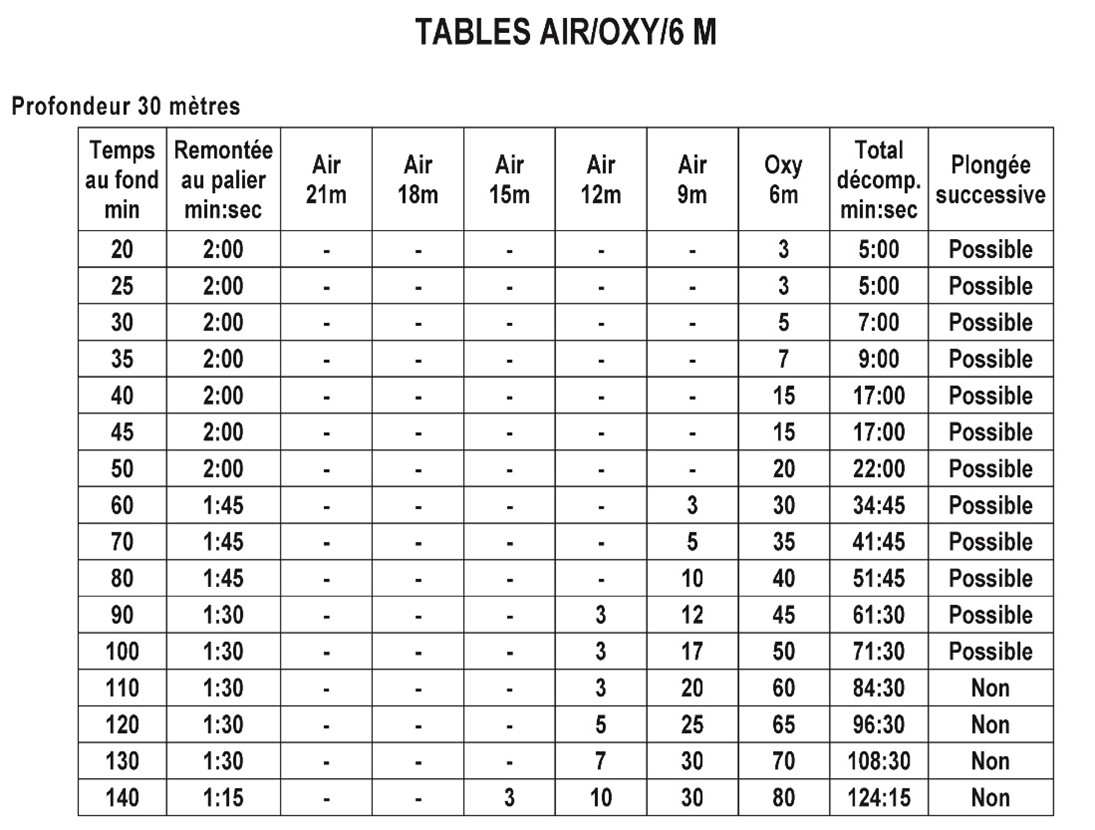
Facsimile of the MT92 “Table 5” (6 msw oxygen) for 30msw table depth.
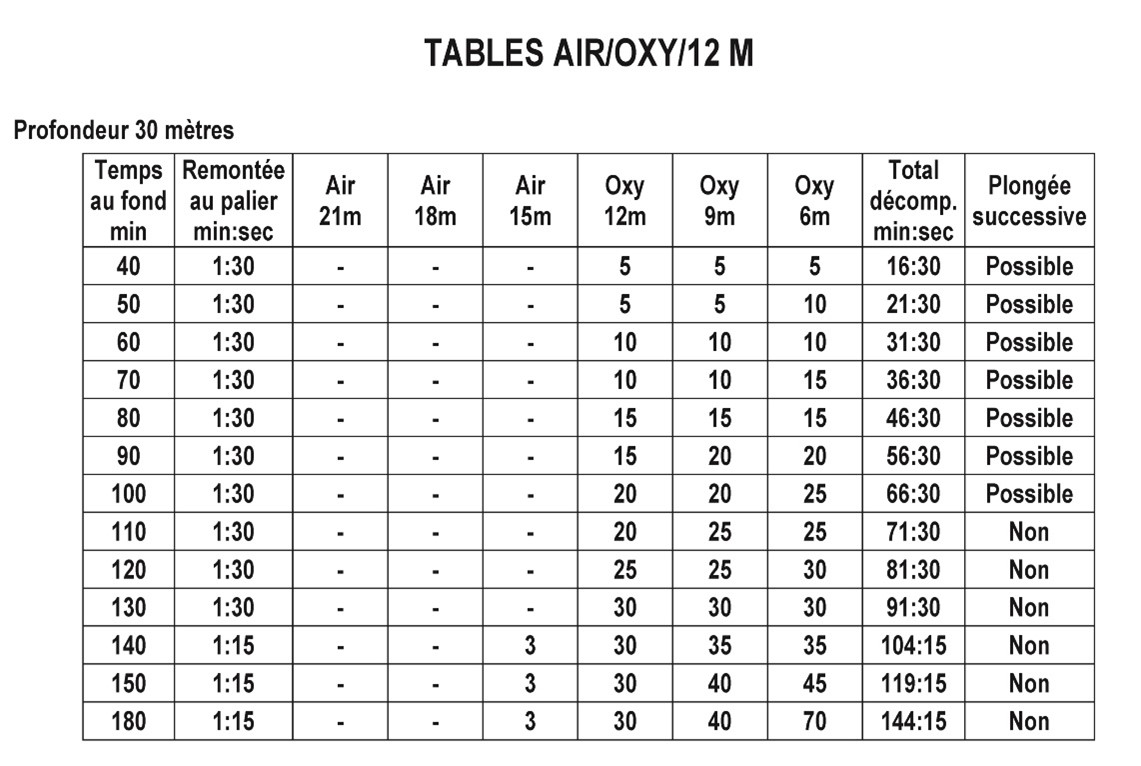
Facsimile of the MT92 “Table 6” (12 msw oxygen) for 30 msw table depth
The latest edition of the French decompression MT 92 tables was published 201211 as an annex to the diving regulations. The French tables hold two decompression procedures that may be applied for TUP-diving. One procedure (Table 5 in the original publication) was developed for open- and closed-bell decompression with Oxygen breathing 12 msw and shallower. The other procedure (Table 4 in the original publication) was developed for in-water decompression with Oxygen breathing at the shallowest 6 msw stop. Oxygen is breathed continuously without air breaks.
The MT 92 tables were initially designed by the French diving company Comex. The Comex database revealed a high DCS incidence in some subgroups of dives decompressing according to the original French 1974 tables34. In 1984 the company developed a new set of tables which was used on Comex worksites between 1986 and 1992 including a large number of air dives from surface to 51 msw on a water pipe installation in Burundi lasting a year. In 1990, these tables were presented to the French Minister of Labor who audited their validation process and reviewed their safety records before they were accepted as official procedures and included in the new diving regulations. The algorithm is a modified perfusion limited model with reduced gradients for compartments with short half times and has been described by Imbert et al.31.
Imbert has reported DCS incidence from this database for dives adhering to the 1974 tables as well as the revised tables developed 198435. From 1976 to 1983 Comex experienced a 0.3% DCS incidence in 64070 dives, but incidence reached 2.1% in the subgroup of the highest PrT index. After table revision DCS incidence was reduced to 0.1% in 33 809 dives completed during 1986-1990. The subgroup with highest PrT reached 0.9% DCS incidence.
DCIEM
The Canadian tables were issued for the first time in 1986 by the Defence and Civil Institute of Environmental Medicine (DCIEM). The latest edition was published in 2009 by Defence R&D Canada10. The tables include procedures for in-water decompression with oxygen breathing. The diver will breathe compressed air at decompression stops 12 msw and deeper, while oxygen is breathed at the shallowest 9 msw stop. A 5 min air break is recommended after 30 min of oxygen breathing. In the event of failure in oxygen provision, the decompression will be changed into a conventional air-decompression procedure. The Canadian tables allow for repetitive diving. The first dive will be awarded a “Repetitive Group”. This Repetitive Group will be converted to a numerical repetitive factor dependent on the surface interval. The equivalent bottom time for a repetitive dive is calculated by multiplying the actual bottom time with the repetitive factor. The principle is similar, but not identical, to the US Navy Diving Manual.
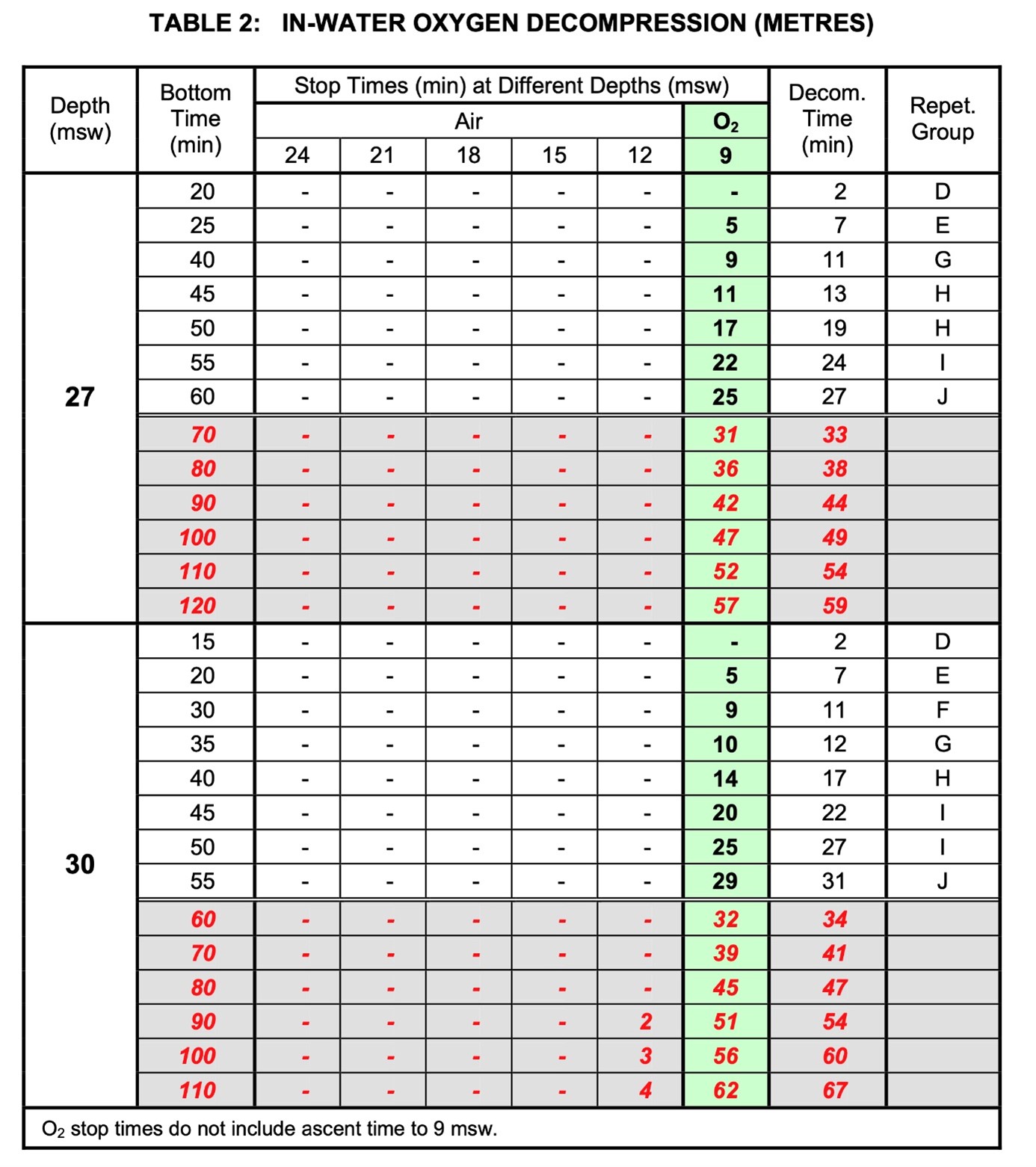
Facsimile from the DCIEM “Table 2” in-water oxygen decompression procedure. 27 and 30 msw table depth
The algorithm has been described in general terms10 and is based on diffusion-limited gas exchange with four serial compartments. The details and parameter set has not been published in public. The Canadian tables have been tested under carefully controlled conditions, including ultrasound surveillance for venous gas embolism. There is no data available to ascertain the extent these tables have been tested using oxygen as the decompression breathing gas.
DCD
The Dutch tables were last time published in 2015 by NDC and are commonly termed the DCD decompression tables12. They are based on an algorithm developed since 1975. The first air decompression tables were published by Vriens Diving and were termed the Vriens-Sterk decompression tables. In 1988, the Netherlands Diving Centre (NDC) asked Sterk to develop the NDC decompression tables, which were published in 1988 and were based on the Vriens-Sterk tables. The 1988 NDC decompression tables were only available in Dutch language. According to the author, the algorithm is a «Neo-Haldanian» sixteen-compartments model with half-times ranging 5-640 min36 (Wouter Sterk, personal communication January 2023), but neither the algorithm nor the parameters have been published in the public domain. The author reported in 1991 that more than 5000 dives completed according to these tables had been registered in a database37. The tables are officially recognized in The Netherlands and are commonly used on the Dutch continental shelf as well as abroad. We have not been able to find data on the use and experience of in-water oxygen decompression. We have included two sets of tables from DCD in our review. The first set are tables designed for wet bell decompression though they can be applied for dry bell decompression as well (Wouter Sterk, personal communication January 2023). The diver breathes oxygen at 9 and 6 msw. A five min air break is recommended after 20 min of oxygen breathing. A new single dive is allowed after a 12 h surface interval. A repetitive dive with air decompression or surface decompression with oxygen is allowed after 2-4 h. These tables have been published in public.
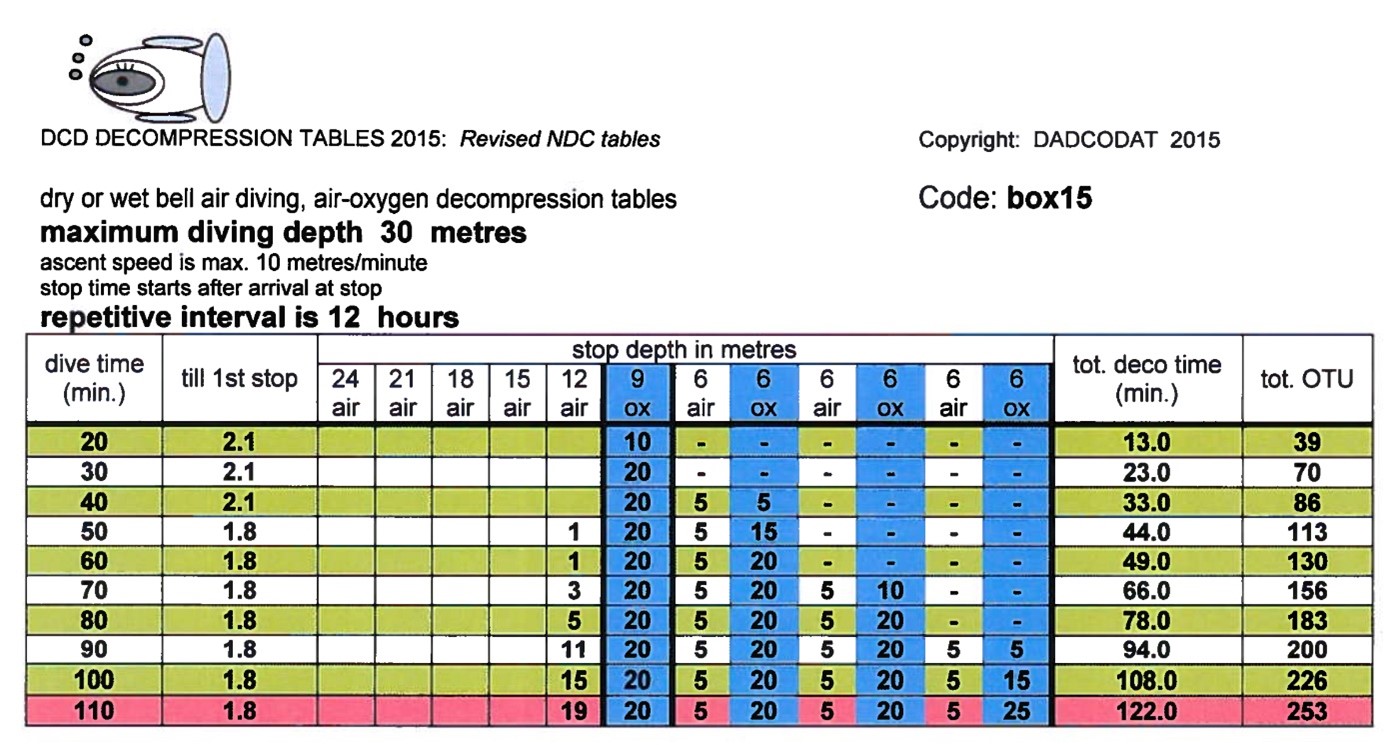
Facsimile from the DCD dry or wet bell decompression procedure. 30 msw table depth. Permission for reproduction Prof Wouter Sterk
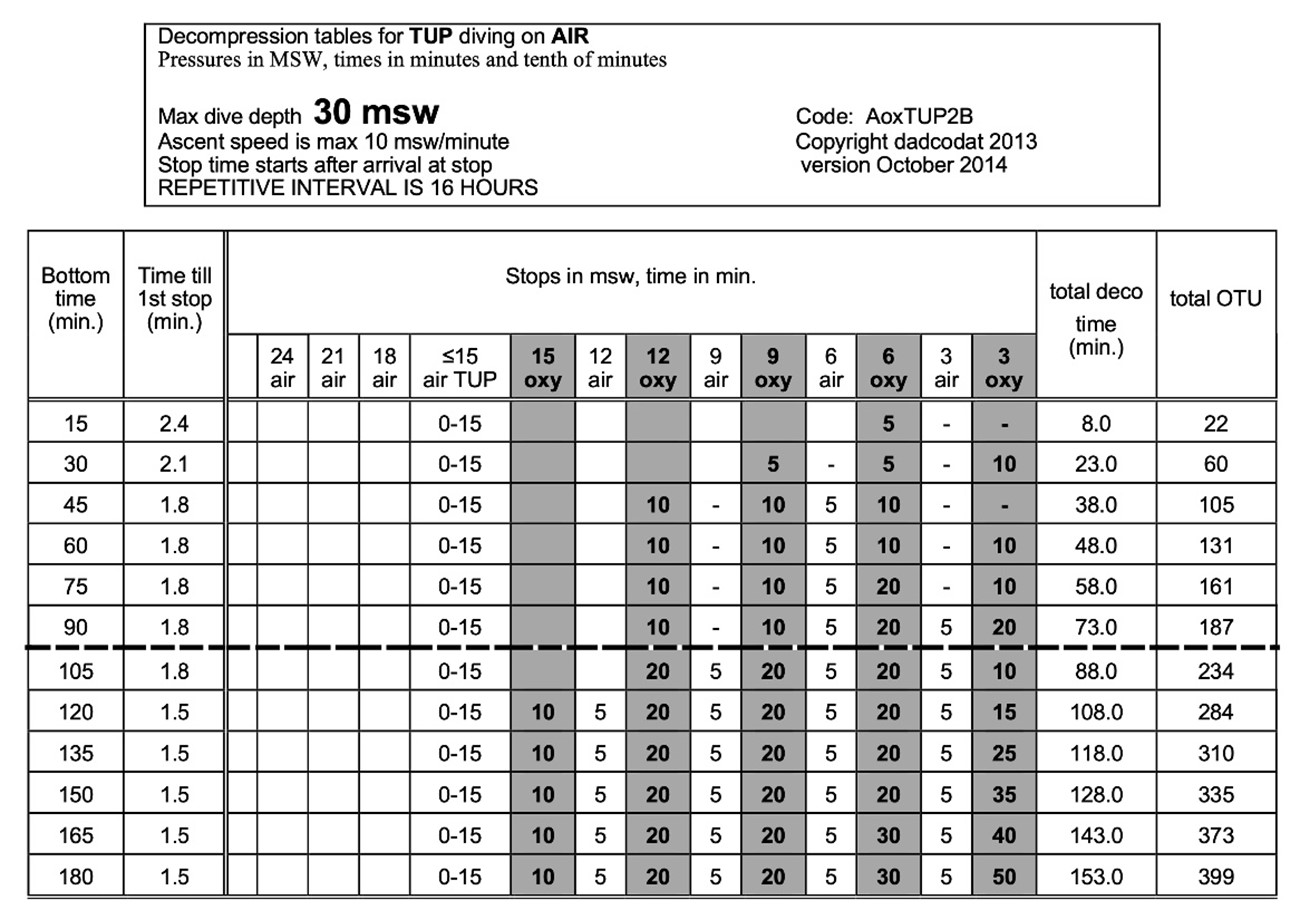
Facsimile from the DCD TUP decomperssion procedure. 30 msw table depth. Permission for reproduction Prof Wouter Sterk
The DCD AoxTUP2B TUP tables (DCD TUP tables) are not published in public but have been developed for the Dutch diving contractor N-Sea by Prof Wouter Sterk. The tables are modification of decompression tables originally developed for caisson work (Wouter Sterk, personal communication, January 2023). The tables range depths from 12 to 51 msw with the diver breathing air as the bottom gas. Compressed air is breathed on decompression stops (3 msw steps) from 24 to 18 msw. The tables are designed to allow the divers 15 min transfer time from the bell to the decompression chamber breathing air. Decompression stops at 15 msw and shallower are planned with oxygen breathing. The shallowest decompression stop is either 6 or 3 msw. A five min air break is planned after every 20 (6 and 9 msw stop) or 10 (15 msw stop) of oxygen breathing. No air break is scheduled during oxygen breathing at 3 msw.
Subsea 7 and Technip
The offshore diving contractors Subsea 7 and Technip submitted their procedures for review. Both companies use MT92 procedures as the basis for their internal procedures. Air breaks have been introduced during oxygen breathing. Random comparisons between the original MT92 tables and the company’s internal procedures disclosed differences in total decompression time in the order of 1-2 min. We consider such differences to be without practical importance and have therefore decided not to use these tables in the comparison.
Additional references
- Imbert JP, Montbarbon S. Use of the Comex diving data base. EUBS Workshop on operational dives and decompression data: collection and analysis; Amsterdam1990.
- Imbert JP. Decompression tables versus decompression procedures: an analysis of decompression sickness using diving data bases. EUBS annual meeting Heraklion, Greece. EUBS; 1991. p. 223–31.
- Sterk W. "SOX" Surface decompression tables in the eastern Scheldt. EUBS annual meeting Rotterdam, The Netherlands. EUBS; 1986. p. 115–23.
- Sterk W. The Netherlands national diving center data base. In: Sterk W, Hamilton RW, editors. EUBS Workshop. Amsterdam, The Netherlands: EUBS; 1990. p. 3–6.