52 - 55



- Super User
- Category: Information
- 6923
Monica Rocco was born in Rome, Italy, where she still lives. Married with two sons, she was educated at the Medical School of Rome, Sapienza University until 1984. She was board certified in anaesthesiology and intensive care medicine (1987) at the same  university and in hyperbaric and subaquatic medicine at the University of Chieti in 1990. Intensive care medicine and hyperbaric and diving medicine have been the mainstreams of her clinical and scientific career. A researcher for a decade, she became Associate Professor in 2004 and Full Professor In Anesthesia and Intensive Care in 2019.
Monica has published widely in the international medical literature with over 130 papers or book chapters. Her current research interests include invasive or non-invasive mechanical ventilation, sepsis and septic shock treatment and investigations, acute renal failure and hyperbaric medicine. Prof Paolo Pelaia, known as one of the fathers of hyperbaric medicine, is her scientific mentor and teacher.
Her main areas of teaching are the pathophysiology and treatment of acute and chronic respiratory failure; clinical symptoms, diagnostic tools and treatment of shock and many hyperbaric and diving topics. She has taught at the School of Medicine in Rome as well as at Scuola Superiore Sant’Anna in Pisa and on many other postgraduate courses. She has been involved in the international cooperation between European diving and hyperbaric centres (COST-B14).
All this whilst running a busy private intensive care medicine facility!
She speaks three languages and loves to travel, discovering new underwater destinations. She had an early passion for all kinds of marine activities, drifting easily into apnoea and scuba diving, she has survived more than 800 wonderful dives.
- Super User
- Category: Information
- 6427
Martin Sayer is the founder and Managing Director of Tritonia Scientific Ltd., that owns and manages the West Scotland Centre for Diving and Hyperbaric Medicine, near Oban. 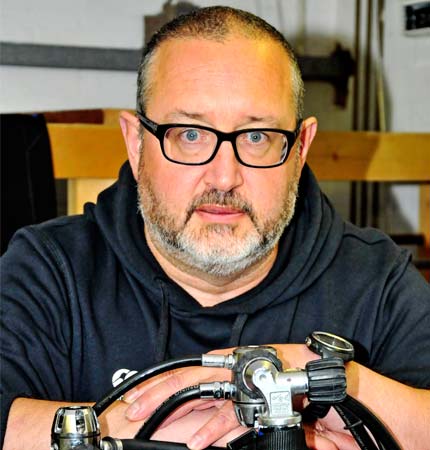 He graduated from the University of Wales (Bangor) in zoology with marine zoology and his doctoral thesis was in animal (fish) physiology. During a brief post-doctoral fellowship, Martin continued research into fish physiology while lecturing in animal and human physiology at Nottingham and Nottingham-Trent Universities. He moved to Scotland in 1991 to work at the government research laboratories at Dunstaffnage and joined both the diving and hyperbaric teams; he took over as head of both units in 1998. Martin has published over 100 peer-reviewed scientific papers, articles and book chapters and is currently the Editor of the journal Underwater Technology. Martin was elected a Fellow of the Society for Underwater Technology in 2002 and given the Inland/Inshore Diving Contractors Science Award in 2006, the Houlder Cup for excellence in diving operations in 2008, and the BSAC Colin MacLeod award in 2012 for furthering international co-operation in diving. He is currently the technical appraiser of hyperbaric services for NHS England and provided the same service for the National Services Division of NHS Scotland 2000-2012. He was the technical representative on the committee of the British Hyperbaric Association 2008–2010. Martin started diving at school for a project that eventually resulted in him winning the European Young Scientist of the Year award in 1979. He has over 6,000 logged dives and has led numerous scientific expeditions to both polar regions and to locations in all the oceans of the world.
- Super User
- Category: Information
- 13144
Simon works as an anaesthesiologist at Auckland City Hospital, a diving physician at North Shore Hospital (Auckland), and is Professor of Anaesthesiology at the University of Auckland. He is widely published with two books and over 170 scientific journal papers or book chapters. He co-authored the 5th edition of 'Diving and Subaquatic Medicine' and the Hyperbaric and Diving Medicine chapters in the last four editions of Harrison’s Principles of Internal Medicine. He has twice been Vice President of the Undersea and Hyperbaric Medicine Society (USA) and in 2010 received the society’s Behnke Award for scientific contributions to diving medicine. 
He has been Editor-in-Chief of Diving and Hyperbaric Medicine Journal since 2019.
Simon has a long career in sport, scientific, commercial, and military diving. He has participated in cutting edge wreck and cave diving expeditions spanning many years. In 2002 he performed the deepest dive to a shipwreck at that time. In February 2023 he was a member of the Wet Mules expedition to the Pearse Resurgence cave in New Zealand where a 230 m dive was conducted using hydrogen as a breathing gas on a deep dive for the first time in over 30 years. He was conferred Fellowship of the Explorers’ Club of New York in 2006, and was the Rolex Diver of the Year in 2015.
Email:
- Super User
- Category: Information
- 6075
I was introduced to baromedical research by the legendary Professor Alf Brubakk as a biophysics student in the mid-1980s. Since then, I did a PhD in DNA repair at the Norwegian Institute of Technology and a post doc in molecular biology at the École supérieure de biotechnologie Strasbourg, followed by a ten-year intermezzo in medical and forensic genetics in Trondheim and Copenhagen before returning to baromedicine in 2009.
Today I work as a senior scientist at the Department of Circulation and Medical Imaging at the Norwegian University of Science and Technology (NTNU) in Trondheim. I’m generally curious about the fundamental biological mechanisms that enable humans to live and work in high-pressure and underwater environments, and what happens when divers experience environmental stress levels that exceed their limits for physiological adjustment. Baromedical research in Trondheim is mostly centered around professional diving through partnerships between universities, industry and regulatory agencies, but my interest in everything ending in -omics has also led to other collaborations on diving-related topics.
- Super User
- Category: Information
- 6330
Neal Pollock was born in Edmonton, Canada. He developed an early passion for aquatics and outdoor adventure, moving from competitive swimming to bicycle touring, skiing, whitewater kayaking and scuba diving by high school. He completed a Bachelor's Degree in Zoology, the first three years at the University of Alberta (Edmonton) and the final year at the University of British Columbia (UBC, Vancouver). He stayed in Vancouver after graduating, working in the diving field, and completing a Master's Degree while serving as university diving officer at UBC. He was able to dive in many locations around the world during this time, including Antarctica. He then moved to Florida to work on a diving research study directed by Dr Richard Vann of Duke University and complete a doctorate in exercise physiology/environmental physiology at Florida State University (FSU). While at FSU he taught anatomy and physiology and exercise physiology to undergraduates and gross anatomy to first-year medical students. He also continued seasonal research diving in the Antarctic. Upon graduation, he taught at East Carolina University (ECU) and then Georgia Southern University while commuting to Duke University to work on environmental physiology studies. He moved to Duke on a full-time basis in 2000, progressively increasing his involvement with Divers Alert Network (DAN) Research. He was recruited to Université Laval in 2016 for a new research chair in hyperbaric and diving medicine, working in the hyperbaric unit at Hôtel-Dieu de Lévis. His research interests focus on human health and safety in extreme environments. He has served as a reviewer for > 40 peer-reviewed journals and has been on the editorial board of Diving and Hyperbaric Medicine since 2008. He still cycles, skis, kayaks, and dives and is quick to accept invitations to interesting places.